

Connected Buildings
Smart building solutions for efficiency and automation
Smart City
Technology solutions for enhanced urban living
Public Safety
Critical communication and safety solutions
Connected Transportation
Technology for smarter, safer transport systems
Smart Factory
Advanced technology for optimized manufacturing
Smart AG Poultry
Innovative technology for efficient poultry farming
Why Is CBRS 2.0 the Right Choice for Private Networks?

Dan O'Malley
Expert in 5G

Table of Contents
ToggleTL;DR
- CBRS 2.0 is the upgraded version of the 3.5 GHz shared spectrum model, enabling more reliable, secure, and scalable private LTE/5G networks.
- Transmit expiry timer extended from 240 seconds to up to 24 hours, Dynamic Protection Areas (DPAs) reduced by 60–90%.
- New GAA coexistence rules improve performance in high-density deployments.
- Seamless integration with 5G Advanced, offering high throughput, low latency, and enterprise-grade security.
- Nybsys solutions like NanoLink small cells and Sentra PTT with Edge AI support CBRS 2.0 with Plug-and-play deployment, Secure, scalable backhaul, Zero Trust security, and Kubernetes-based architecture for high scalability.
- Compared to Wi-Fi 6E, CBRS 2.0 offers 2–3× greater coverage, lower latency and more reliable performance, full network control with SIM-based security and better suitability.
CBRS 2.0, the strategic upgrade to its predecessor CBRS 1.0, has introduced smarter interference models, longer transmit windows, and reduced protection zones. It makes using the 3.5 GHz mid-band spectrum more usable for many operators 1.
With smarter interference protection, 24 hour transmit windows, and dramatically smaller Dynamic Protection Areas (DPAs), CBRS 2.0 enables carrier class reliability without sacrificing the low cost, shared spectrum model that made CBRS so attractive to enterprises in the first place.
Nybsys NanoLink small cell platform and Sentra PTT Edge AI suite are CBRS 2.0 ready today, giving organizations a plug and play on ramp to secure, scalable private LTE/5G networks that integrate seamlessly with Zero Trust security and Gen AI enhanced communications.
According to the NTIA, recent rule changes have expanded unencumbered CBRS access to approximately 240 million people across 17 states 2. That’s a major leap from previous coverage, opening the door for multiple frequency channels and denser deployments.
CBRS has heavily influenced the global private LTE/5G market. It is projected to reach USD 36.08 billion by 2030, growing at a CAGR of 54.1% from 2024 to 2030 3. This growth underscores the need for more reliable and scalable network solutions and CBRS 2.0 is what we need.
How CBRS Framework Works
For years, the 3.5 GHz band (3550-3700 MHz) remained largely underutilized for commercial purposes in the United States. This mid-band spectrum was primarily reserved for critical federal operations, including naval radar systems 4.
CBRS is a synergy of policy, technology, and automation. The system is built around a shared spectrum model in the 3.5 GHz band. This tiered access model facilitates efficient spectrum sharing while protecting incumbent users.
In simple words, it allows different types of users to operate simultaneously without causing harmful interference.
CBRS operates on three tiers:
- Incumbent Access (Tier 1): This includes federal users like the U.S. Navy and satellite ground stations. Their operations take priority, and they must be always protected.
- Priority Access Licenses (PALs) (Tier 2): These licensed users purchase access to specific geographic areas. They get better interference protection than unlicensed users.
- General Authorized Access (GAA) (Tier 3): These users don’t need a license. They can use the spectrum opportunistically, but they must accept interference from both Tier 1 and Tier 2 users.

You may find more interesting information about CBRS tiers on this blog: What is CBRS and How Can It Benefit Your Enterprise Business?
Beyond these tiers, two key components manage the spectrum: Spectrum Access System (SAS) and Environmental Sensing Capability (ESC).
- SAS is a cloud-based service that dynamically assigns user frequencies based on availability and interference risk. It ensures that federal users are protected while maximizing spectrum use for everyone else 5.
- ESC sensors detect when federal systems are active, especially in coastal regions, and alert the SAS to clear the spectrum. Without ESC, the system couldn’t respond quickly enough to protect against incumbent operations.
From CBRS 1.0 to 2.0: Challenges and Drivers
CBRS 1.0 certainly introduced a unique approach to spectrum sharing. It was a smart idea, but not without issues. In fact, initial deployments highlighted several areas needing refinement.
- One significant concern was the conservative nature of Spectrum Access System (SAS) protocols.
- Another challenge stemmed from the short transmit expiry timers.
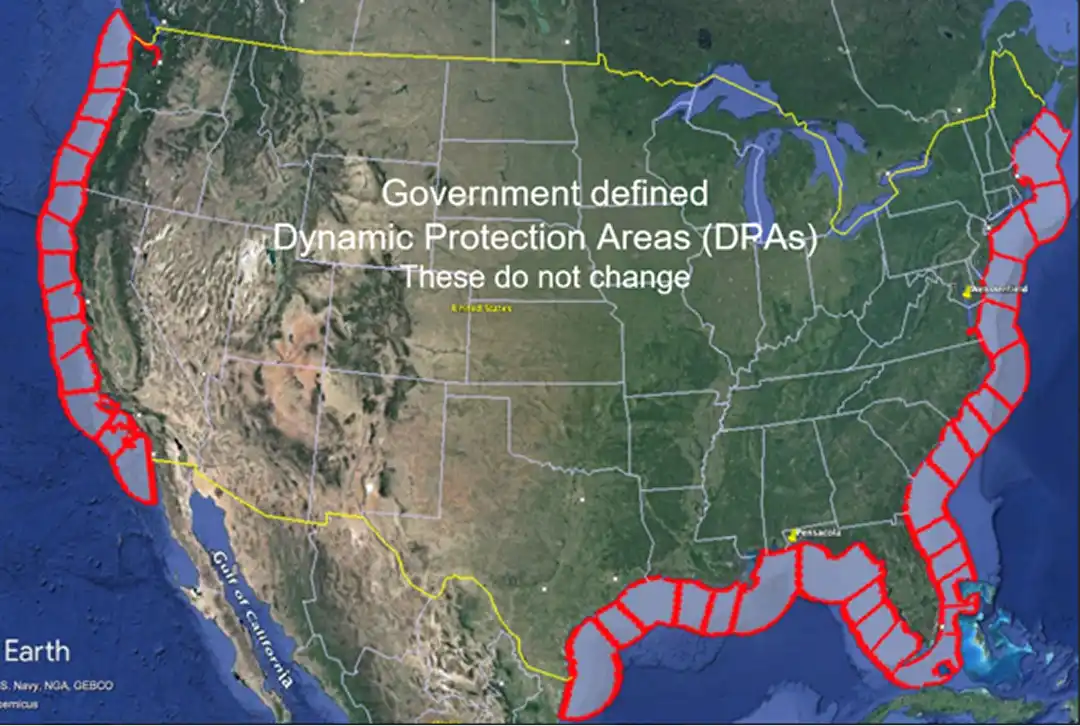
- Interruption in DPA zones while incumbent military radar was detected.
Coastal DPA boundaries (source: ONGO Alliance)
- General Authorized Access (GAA) had no protection from interference.
It goes without saying that GAA users also faced challenges. The initial framework provided limited interference protection for GAA operations. It means multiple GAA users in dense areas could interfere with each other, impacting overall network performance. They had to accept disruptions from both Priority Access License (PAL) holders and federal users.
It’s worth mentioning that by early 2025, over 400,000 CBRS base stations were registered with SAS. Still, many in rural areas have limited connectivity options. However, even with this growth, the limitations of CBRS 1.0 made it hard to rely on for critical applications.
On the other hand, raising power levels to improve coverage isn’t a simple fix. It could increase interference, especially in GAA channels, and disrupt the balance between commercial and federal users. That’s why the FCC and industry stakeholders have focused on smarter interference models and better coordination instead of just boosting signal strength.
Core Enhancements in CBRS 2.0
So, what are the potential benefits of CBRS 2.0? Or what makes it better than CBRS 1.0?
CBRS 2.0 brings targeted core enhancements to address the challenges or limitations of the initial framework. These enhancements are designed to optimize spectrum use, reduce interference, and improve network stability for both licensed and unlicensed users.
Extended Transmit Expiry Timer
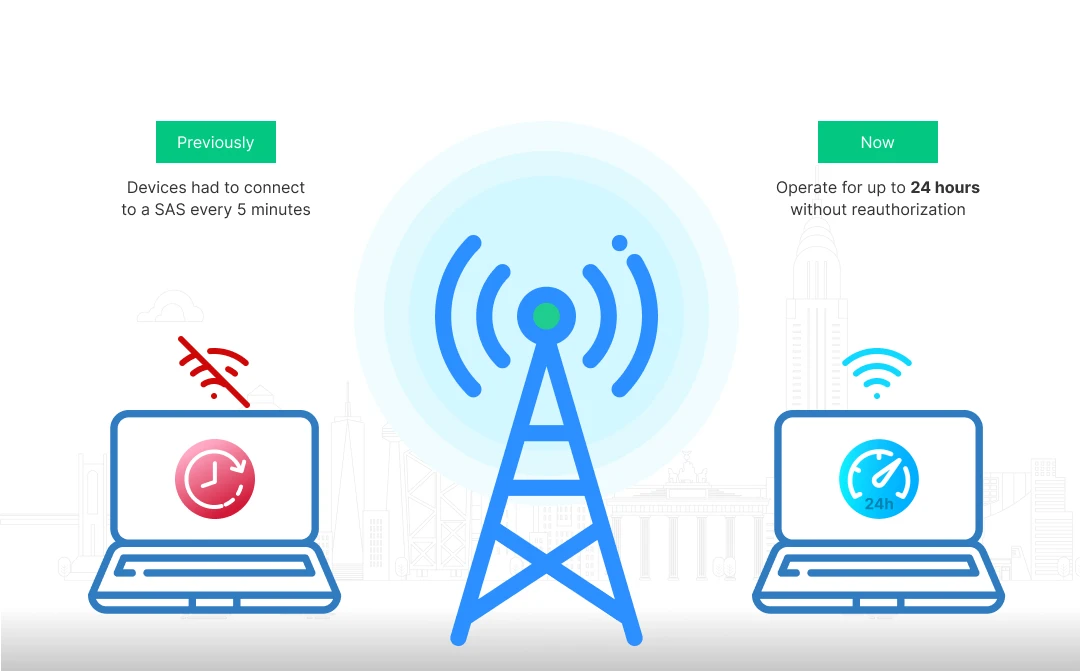
Notably, the most impactful change is the extension of the transmit expiry timer. Previously, CBSDs had to shut down within 240 seconds if they lost contact with the SAS. These frequent disruptions were more noticeable in industrial environments.
Now, devices outside DPA neighborhoods, and those in the upper 50 MHz within DPA neighborhoods, can operate for up to 24 hours without SAS reauthorization 6. This change dramatically increases network stability, especially when connectivity to the SAS might be intermittent. Also, it helps in reducing service interruptions, especially for enterprise and private networks.
Smarter Interference Models and Reduced DPA Zones
The original (earlier) interference models used by SAS providers were overly conservative. To protect naval radar systems, they created large Dynamic Protection Areas (DPAs), sometimes extending over 430 km inland. Hence, the FCC, NTIA, and Department of the Navy approved a new aggregate interference model.
The new model substantially reduces the size of DPA neighborhoods, particularly for CBSDs operating at lower heights (under 6 meters above ground level). So, approximately 72 million more people nationwide will gain access to CBRS without periodic interruptions due to incumbent activity. It expands coverage from 49% to 91% of the population 8.
As a result, many previously restricted coastal and federal facility areas become viable for reliable commercial CBRS deployments. Also, commercial access has expanded to cover over 240 million people across 17 states 9.
Collaborative GAA Coexistence Rules
General Authorized Access (GAA) users previously had no protection from interference and limited control over frequency planning. In CBRS 2.0, a new voluntary mechanism now facilitates interference mitigation among GAA operators in dense deployments 10.
The new framework allows user-driven frequency planning and coordination. It leads to a smoother network experience for all GAA users. This is a crucial step towards optimizing spectrum utilization in areas with high GAA device density, especially in dense urban deployments and industrial zones.
Implementation by SAS Providers and OEMs
SAS providers and equipment manufacturers are already implementing all these enhancements. Most providers have started with 6-hour implementations to ensure compliance and stability while the FCC permits up to 24-hour expiry timers. This phased rollout reflects a cautious but forward-moving approach to adopting CBRS 2.0 standards.
Advanced SAS Governance and Refined ESC Operations underpin these improvements. SAS providers now implement more sophisticated algorithms for spectrum allocation. They incorporate predictive analytics for better interference avoidance 11.
Preserving the Low-Power Framework
CBRS 2.0 maintains the low-power, small-cell architecture that makes it ideal for localized deployments. Proposals to raise power levels have been rejected due to risks of increased interference and reduced spectrum reuse 9. The current framework supports flexible, scalable networks without compromising national security or commercial autonomy.
Technical Innovations Driving CBRS 2.0
Beyond the core enhancements, CBRS 2.0 introduces smarter systems and more efficient tools. These things make spectrum sharing faster, safer, and more reliable. Also, these innovations are already reshaping how private networks operate across industries.
Dynamic Spectrum Allocation (DSA)
DSA uses AI and ML to predict and manage real-time spectrum usage. It helps reduce interference. Operators can ensure that the spectrum is used efficiently, even in high-demand environments.
With DSA, networks can adapt instantly to changing conditions. It is essential for applications like industrial automation and smart cities.
Advanced SAS Governance
The Spectrum Access System (SAS) has also evolved. CBRS 2.0 introduces stricter governance protocols that improve coordination between multiple SAS providers. These updates reduce disputes and make spectrum allocation more predictable.
Alternatively, they also support better tier interaction. It ensures that GAA users don’t get pushed out by PAL holders unnecessarily.
Improved Propagation Models
The new aggregate interference model, approved by the FCC, NTIA, and Department of the Navy, uses more realistic propagation loss calculations 2. This includes factoring in clutter loss, particularly for CBSDs operating at lower heights, which reduces the perceived interference impact of CBRS devices by approximately 8 dB.
This refinement allows for more accurate interference calculations and, consequently, smaller Dynamic Protection Areas (DPAs). It expands the available spectrum suitable for commercial use 10.
Security Enhancements and 5G Integration
It’s worth mentioning that CBRS 2.0 strengthens security protocols. These include encrypted device authentication and improved data privacy measures. Besides, it is designed for integration with 5G Advanced and future cellular technologies.
The alignment is important for enterprises looking to deploy private 5G networks as it ensures compatibility and supports advanced application scenarios requiring high throughput, latency, reliability, and connection density.
How Does CBRS 2.0 Benefit Your Business?
CBRS 2.0 delivers real-world improvements in performance, reliability, and cost-efficiency. These benefits are already being seen across industries deploying private LTE and 5G networks.
Improved Network Stability and Predictability
Networks can operate with fewer disruptions and more consistent throughput with extended transmit expiry timers and refined interference models. This is especially important for mission-critical applications in healthcare, manufacturing, and logistics, where downtime is not an option.
Lower Operational Costs
CBRS allows enterprises to build private networks without purchasing expensive spectrum licenses. By leveraging GAA, organizations can deploy secure, high-performance wireless infrastructure at a fraction of the cost of traditional LTE. It makes it easier to scale up without scaling costs.
Optimized Spectrum Efficiency
Dynamic Spectrum Allocation (DSA) and AI-driven traffic management help optimize how spectrum is used. These technologies reduce congestion and improve resource utilization, even in high-density environments like stadiums, airports, and urban campuses.
Enhanced Coverage and Range
Compared to Wi-Fi, CBRS-based private LTE networks offer broader coverage with fewer access points. So, it is ideal for large facilities such as warehouses, ports, and university campuses. Advanced propagation models and MIMO technology further extend signal reach and reliability.
Reduced Latency for Real-Time Applications
CBRS 2.0 supports low-latency communication, essential for real-time data processing, automation, and emergency response. Whether it’s remote patient monitoring, autonomous vehicles, or industrial robotics, the system delivers fast, uninterrupted connectivity.
Security and Control
Private LTE networks built on CBRS offer enterprise-grade security features, including encrypted data transmission, private SIM authentication, and firewall integration. This gives organizations full control over their network infrastructure. Also, it reduces reliance on third-party carriers and minimizes exposure to cyber threats.
Scalability and Flexibility
It goes without saying that CBRS 2.0 supports flexible deployment models. Whether you’re operating in a rural area or a dense urban zone, the system adapts to your needs. Enterprises can start small and scale up as demand grows, without reconfiguring their entire network.
Industry Applications of CBRS 2.0
The enhanced capabilities of CBRS 2.0 are significantly broadening its applicability across diverse industries.
Manufacturing & Warehousing
Private CBRS networks provide robust security for sensitive operational data and reliable, low-latency connectivity for automated guided vehicles (AGVs), robotics, and real-time predictive maintenance systems. Platforms like Nybsys Sentra enable seamless human-machine collaboration in these complex environments.
Smart Mining
CBRS 2.0 enables reliable connectivity in remote and underground mining sites. It supports low-latency communication for tele-operation of autonomous vehicles and machinery, enhances worker safety, and allows for real-time data collection from drilling equipment and sensors.
Healthcare
We see its impact on healthcare, where secure and reliable communication systems are critical. CBRS 2.0 enables telehealth scalability and supports connected medical devices like pacemakers and blood pressure monitors.
It ensures low latency and uninterrupted service for critical operations. It also enhances hospital operations, including asset tracking, connected medical devices, telehealth services, and supply chain management.
Education
Schools and universities can use CBRS 2.0 to provide campus-wide broadband, secure digital learning platforms, and connectivity for underserved areas. It’s a cost-effective alternative to traditional Wi-Fi and fiber.
Manufacturing & Industrial IoT
Private CBRS networks in these environments offer robust security and control over sensitive operational data. Besides, they support the operation of automated guided vehicles (AGVs), robotics, and real-time data monitoring for predictive maintenance systems.
Transportation & Logistics
Smart sensors, forklifts, and asset tags in warehouses running with CBRS 2.0 ensure devices remain connected even with metal obstructions or moving machinery. This technology is also vital for port and airport operations, improving critical infrastructure monitoring and baggage handling.
Retail & Hospitality
If you are a retailer, you can also benefit from CBRS 2.0. Use it for in-store analytics, secure point-of-sale systems, and guest Wi-Fi alternatives. Hotels and resorts benefit from private LTE or 5G networks to enhance customer experience and operational control.
Defense & Public Sector
CBRS 2.0 provides secure, dedicated networks for tactical communications and emergency response. Nybsys’s Sentra platform can integrate with existing Land Mobile Radio (LMR) systems, creating a unified network for first responders that combines voice, data, and video.
CBRS 2.0 vs. Wi-Fi 6E: Key Differences
| Feature | CBRS 2.0 | Wi-Fi 6E |
|---|---|---|
| Spectrum | 150 MHz shared/licensed | 1200 MHz unlicensed |
| Coverage Range | 2–3× Wi-Fi; < 1 W EIRP | Short (< 50 m indoors) |
| QoS | SIM QoS class, deterministic | Best effort |
| Latency / Performance | 100 Mbps to 1 Gbps (real-world); low latency (20–40 ms) | Up to 1.5 Gbps; latency varies (10–100 ms) depending on congestion |
| Security | SIM-based authentication, encrypted traffic, private control | WPA3 encryption; shared access, less control over traffic |
| Deployment Complexity | Requires certified equipment and SAS coordination | Plug-and-play; easier for small-scale setups |
| Cost Structure | Lower long-term cost for large deployments; no carrier fees | Lower upfront cost; higher maintenance in dense environments |
| Device Compatibility | Requires CBRS-compatible devices | Broad compatibility with most consumer and enterprise devices |
| Use Cases | Industrial IoT, smart cities, healthcare, logistics, education | Office Wi-Fi, guest networks, public venues, BYOD environments |
| Interference Risk | Medium; managed via SAS and ESC systems | High; especially in crowded or overlapping deployments |
| Network Control | Full control over network policies and traffic | Limited control; shared access among users |
What are the Differences Between CBRS 1.0 and CBRS 2.0?
Both versions operate within the same 3.5 GHz mid-band spectrum and maintain the three-tiered access model. However, CBRS 2.0 introduces critical refinements that address the limitations of the initial framework.
| Feature | CBRS 1.0 | CBRS 2.0 |
|---|---|---|
| Transmit Expiry Timer | 240 seconds | 6–24 hours (improves network resilience) |
| Dynamic Protection Areas (DPAs) | Large, conservative zones limiting access | Reduced zones with smarter interference models (60-90% smaller) |
| GAA User Experience | No interference protection; unpredictable performance | Collaborative coexistence rules; better frequency planning |
| SAS Protocols | Conservative; limited coordination | Advanced governance; multi-SAS coordination |
| Propagation Models | Basic; limited terrain awareness | Terrain and clutter-aware models for precise interference calculation |
| Spectrum Efficiency | Lower due to overprotection and limited reuse | Higher efficiency through optimized sharing |
| Network Stability | Frequent disruptions due to short expiry and interference | Improved stability with longer expiry and better coexistence |
| Use Case Suitability | Limited to non-critical applications | Suitable for mission-critical and industrial deployments |
| Security & Control | Basic; dependent on public infrastructure | Enhanced security; full control over private networks |
| Deployment Flexibility | Restricted in DPA-heavy regions | Expanded coverage to over 240 million people across 17 states |
| Integration with 5G | Limited | Seamless integration with 5G Advanced features |
Nybsys & CBRS 2.0: Accelerating Private Network Deployment
Nybsys leverages the advanced capabilities of CBRS 2.0 to deliver robust, end-to-end private network solutions.
The Nybsys Nanolink platform, a family of CBRS-certified LTE/5G femtocells and picocells, fully supports the new framework and is designed for rapid, scalable deployment.
Key features include:
- Plug-and-Play Deployment: Nybsys small cells feature AI-enabled Self-Organizing Network (SON) capabilities for zero-touch self-configuration and auto-optimization, drastically reducing manual planning and deployment costs.
- Backhaul Flexibility and Security: The Nanolink operates over public internet or private links, using IKEv2/IPSec tunnels to ensure all communications are secure.
- Flexible Spectrum Use: Nybsys solutions work seamlessly with both licensed (PAL) and unlicensed (GAA) spectrum, featuring smart, DPA-aware configurations.
- Highly Scalable Architecture: Built on Kubernetes, Nybsys femto gateways and aggregators are reliable and can scale to support millions of sessions, accommodating growth from a few small cells to thousands.
What Nybsys Does for CBRS 2.0 Deployments
We offer products such as NanoLink 2300 series small-cells, Sentra Push-to-Talk (PTT) with Edge AI, and Zero-Trust fabric technology to adopt CBRS 2.0.
| Products | Features |
|---|---|
| NanoLink 2300 series |
|
| Sentra PTT + Edge AI |
|
| Zero-Trust Security |
|
Frequently Asked Questions
CBRS 2.0 is an upgraded version of the Citizens Broadband Radio Service. It offers improved spectrum sharing, network stability, and support for private LTE and 5G deployments.
CBRS operates in the 3.5 GHz band (3550–3700 MHz).
Yes. It’s ideal for enterprises needing secure, scalable, and cost-effective wireless connectivity.
Yes. CBRS 2.0 supports integration with 5G Advanced technologies.
Yes. It supports encrypted communication, SIM-based authentication, and private data control.
Final Words
As we reflect on the journey of CBRS and the significant advancements brought by CBRS 2.0, it is clear that we are witnessing a fundamental shift in wireless connectivity. The evolution from a federally exclusive band to a dynamically shared spectrum has unlocked unprecedented innovation and economic growth opportunities.
We have seen how CBRS 2.0, with its refined DPA management, extended heartbeat timers, and collaborative coexistence mechanisms, directly addresses the operational challenges of its predecessor, paving the way for more stable and predictable wireless deployments.
These enhancements empower private networks across diverse industries, from manufacturing and healthcare to education and smart cities, enabling mission-critical applications and driving digital transformation.
Furthermore, CBRS 2.0 strengthens Fixed Wireless Access, offering a robust solution to bridge the digital divide and provide high-speed internet to underserved communities.
We believe that CBRS 2.0 is not merely an upgrade but a testament to the power of collaborative innovation in spectrum management, setting a new standard for how we will connect in the future.
References:
- https://ongoalliance.org/resource/what-is-cbrs-2-0/
- https://frankrayal.com/2024/06/19/cbrs-2-0-the-impact-of-new-rules-on-boosting-deployments-with-unencumbered-spectrum-access/
- https://www.grandviewresearch.com/industry-analysis/private-5g-network-market
- https://www.fcc.gov/wireless/bureau-divisions/mobility-division/35-ghz-band/35-ghz-band-overview
- https://blinqnetworks.com/cbrs-sas-spectrum-sharing-guide/
- https://www.ericsson.com/en/blog/north-america/2024/cbrs-2-0-a-new-era-for-network-stability-and-investment
- https://www.rcrwireless.com/20250408/spectrum/cbrs-spectrum
- https://www.googlecloudcommunity.com/gc/Cloud-Product-Articles/SAS-CBRS-2-0-Release/ta-p/783931
- https://spectrumfuture.com/wp-content/uploads/2025/02/SFTF-WTAS-Two-Pager_12.16.24.pdf
- https://www.prnewswire.com/news-releases/ongo-alliance-unveils-cbrs-2-0–substantially-bolstering-reliability-and-performance-of-cbrs-networks-302174950.html
- https://www.fierce-network.com/wireless/federated-wireless-completes-esc-network-for-cbrs