
TL;DR
- Disaggregated routing separates routing software, hardware, management, and security layers.
- It helps enterprises, ISPs, telecom operators, and data centers reduce vendor lock-in and scale faster.
- Instead of depending only on centralized routing, intelligence can move closer to the edge.
- The NOS layer matters because SONiC, IP Infusion, Arrcus, DriveNets, and other platforms show how routing software ecosystems are evolving.
- Disaggregated routing can support BGP, OSPF, and enterprise routing protocols when the selected NOS and hardware platform support them.
- Nybsys offers disaggregated routing through KenAI, a Nybsys-owned routing solution.
- KenAI includes routing hardware, Nybsys software, Layer 2 and Layer 3 switching and routing, deployment support, and Nexus network management.
What Is Disaggregated Routing?
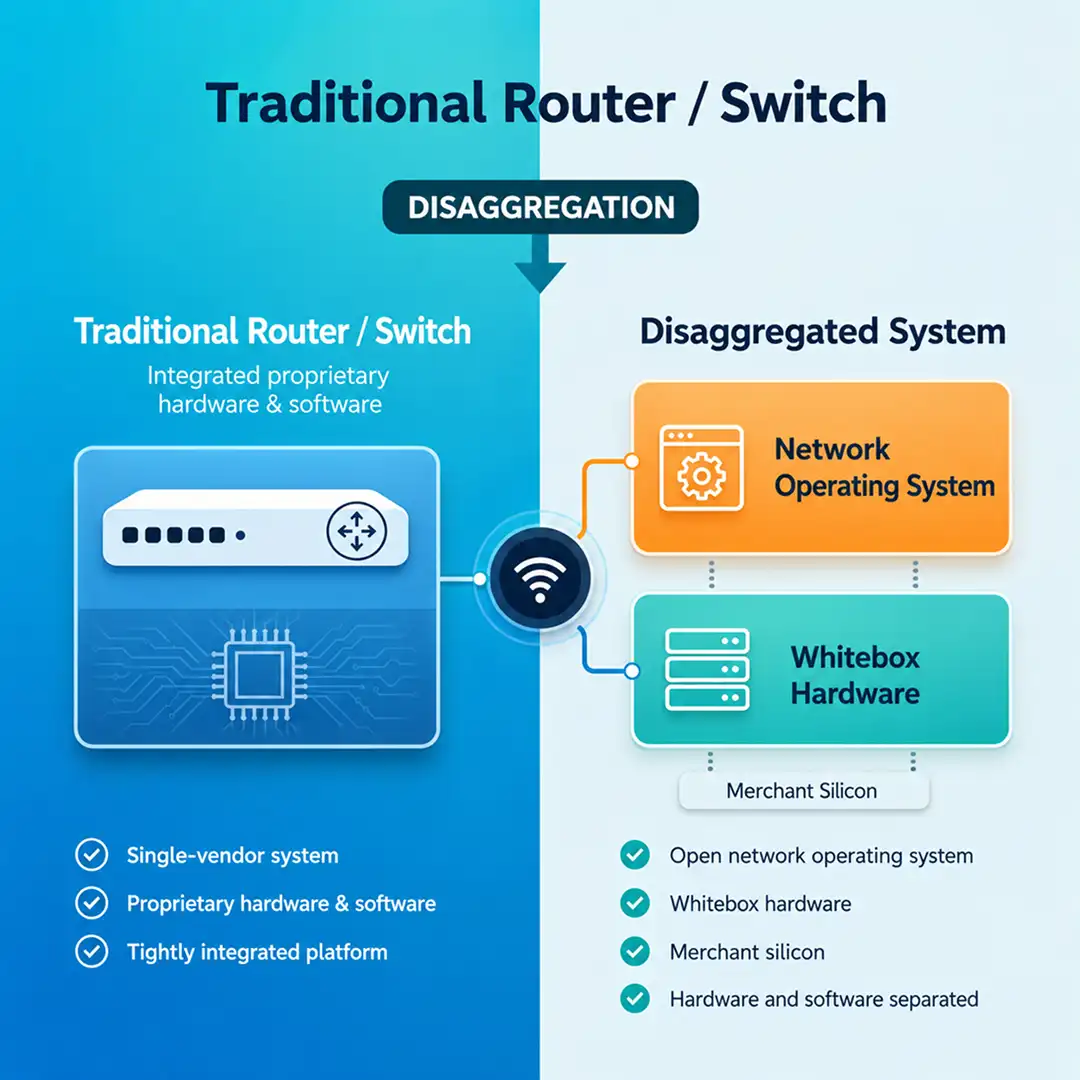
Disaggregated routing is a network architecture that separates routing software from the underlying routing hardware.
In a traditional router, the hardware, operating system, software features, vendor support, licensing, and upgrade path are usually bundled into one closed system. That model is familiar, but it can limit flexibility when the network grows.
Disaggregated routing changes that model.
It allows network operators to separate the hardware layer, software layer, control functions, data forwarding, management, and deployment model. This gives teams more control over how they build, scale, monitor, and upgrade routing infrastructure.
In simple terms, disaggregated routing helps move routing intelligence closer to the edge of the network.
Instead of depending only on large centralized routing systems, organizations can deploy routing capacity where traffic demand is growing. This is especially useful for networks that support broadband users, 5G sites, enterprise branches, cloud access, IoT traffic, and edge services.
Why Traditional Routing Is Becoming Harder to Scale
Traditional routing was built around a more controlled and centralized model.
That worked well when networks were simpler. But today’s traffic is more distributed. Users are not only inside one office. Applications are not only inside one data center. Devices, branches, towers, multi-cloud networking environments, and edge locations all create new routing demand.
Ericsson reported that mobile network data traffic grew 20% between Q3 2024 and Q3 2025. Its Q4 2025 update also reported that total monthly global mobile network data traffic reached 200 EB, with video accounting for 76% of mobile data traffic .
This type of growth creates pressure on routing infrastructure.
If too much traffic depends on a central routing point, the network can become harder to scale. Upgrades may require large hardware refreshes. Capacity planning becomes expensive. Vendor-specific licensing can also make scaling more difficult.
Traditional monolithic routing can also lock operators into one vendor’s roadmap. If the software and hardware are tied together, the customer has fewer choices. They may have to wait for one vendor’s upgrade cycle, pricing model, and supported hardware options.
Disaggregated routing gives network teams another path.
It allows routing infrastructure to scale in a more flexible way, especially at the edge.
Disaggregated Routing vs Traditional Routing
The biggest difference is control.
Traditional routing gives you one bundled system. Disaggregated routing gives you an architecture made of flexible layers.
In a traditional model, the router comes as a complete package from one vendor. This includes hardware, routing software, support, and lifecycle management. It may be easier to buy, but it can be harder to change.
In a disaggregated model, the hardware and software can be separated. Network teams can choose the right hardware, software, management, and deployment approach for each use case.
The table below shows the practical difference between the two models:
| Comparison Point | Traditional Routing | Disaggregated Routing |
|---|---|---|
| Architecture | Closed, bundled router stack. | Layered hardware, NOS, control, management, and support. |
| Hardware Choice | Limited to one vendor’s chassis, line cards, and refresh cycle. | Choose a platform by capacity, port density, footprint, and cost. |
| Software / NOS | Proprietary software tightly coupled to the hardware. | NOS can be open, commercial, or integrated with validated hardware. |
| Scalability | Capacity often follows large refresh cycles. | Scale closer to edge, aggregation, or core demand. |
| Upgrade Path | Hardware and software upgrades are usually linked. | Upgrade hardware, NOS features, tools, and services more independently. |
| Vendor Dependency | One roadmap, pricing model, licensing path, and support motion. | More choice across hardware, software, and support models. |
| Management | Often managed through vendor-specific tools. | Can integrate with NMS, automation, ZTP, provisioning, and monitoring. |
| TCO Impact | Higher risk of overbuying, lock-in, and lifecycle cost pressure. | Better hardware choice, lifecycle control, and cost-effective scaling. |
How Disaggregated Routing Reduces TCO
Disaggregated routing can reduce the total cost of ownership when teams avoid replacing a full bundled router stack for every capacity or feature change. Instead of buying one closed hardware-and-software package, operators can choose hardware by performance, footprint, port density, and price.
Independent upgrades are another cost advantage. Hardware, NOS features, licenses, and management tools can be evaluated on their own life cycles. This can reduce unnecessary refreshes and make upgrades easier to align with real traffic growth.
Reduced vendor dependency also improves commercial flexibility. When teams have more choice across hardware, software, and support models, they are less tied to one vendor roadmap, one pricing model, or one upgrade schedule.
Better lifecycle management is the long-term value. Network teams can pilot changes, scale routing closer to demand, refresh only the layer under pressure, and avoid buying more capacity than they need too early. GSMA also notes that disaggregated routing can reduce CapEx and OpEx by lowering vendor lock-in, increasing vendor choice, supporting faster innovation, and enabling more cost-effective scaling.
Why Enterprises and Operators Need More Choice
Network teams do not always want the same hardware and software for every location.
A core site, data center, branch, broadband edge, mobile cell site, and private network environment may all have different needs. One may need higher capacity. Another may need a smaller footprint. Another may need better cost control. Another may need easier operations.
Traditional routing often limits that choice.
GSMA explains that monolithic routers force operators to buy bundled hardware and software from one vendor for the lifecycle of the router. This can lead to suboptimal decisions. A vendor may have strong software but weaker hardware for a specific use case. Another vendor may have better hardware but not the software the operator wants.
Disaggregated routing solves this by opening the ecosystem.
GSMA notes that the disaggregated routing market includes at least 15 white-box vendors and at least 10 network operating system options. This gives operators more room to match the right hardware and software to the right network requirement.
For enterprise network leaders, this matters because flexibility lowers dependency risk.
For telecom operators and ISPs, it can also improve price competition and make future upgrades less painful.
The Role of Network Operating Systems (NOS)
Network operating systems are central to disaggregated routing because they provide the routing features, interface control, telemetry, security controls, and hardware abstraction above the physical platform.
SONiC4 is an open-source, Linux-based NOS with a broad ecosystem across switches, ASICs, and cloud-style network environments. In disaggregated routing discussions, it is often used as an example of how hardware and software can be separated while still supporting production network functions.
IP Infusion5 represents the commercial NOS side of the ecosystem through OcNOS. It is relevant for service provider, data center, and enterprise environments that want routing features, platform support, and hardware choice without building every integration themselves.
Arrcus6 is another example of a routing software ecosystem built around cloud-to-edge networking. Its ArcOS and ACE portfolio shows how disaggregated routing can include modern control, automation, routing security, and distributed network use cases.
DriveNets takes a network cloud approach by combining NOS software, white-box hardware, and orchestration. It shows how disaggregation can move beyond a single device and become a software-driven routing architecture for large service provider and cloud networks.
These examples are not included to promote one NOS over another. They simply show that disaggregated routing is an ecosystem of NOS software, white-box platforms, automation tools, support models, and deployment choices.
Can Disaggregated Routing Support BGP and OSPF?
Disaggregated routing can support common enterprise and service provider routing protocols when the selected NOS and hardware platform support them. Before production rollout, teams should validate BGP, OSPF, route redistribution, ECMP, BFD, IPv6, failover behavior, and policy controls in the lab.
BGP disaggregated routing is especially useful for service provider, data center, peering, and leaf-spine environments where route scale and policy control matter. OSPF routing is still useful for enterprise and transport networks that need familiar interior gateway routing. The main point is simple: disaggregation changes the hardware and software model, but it does not remove the need for proven routing protocols.
How NYBSYS KenAI Fits Into Disaggregated Routing
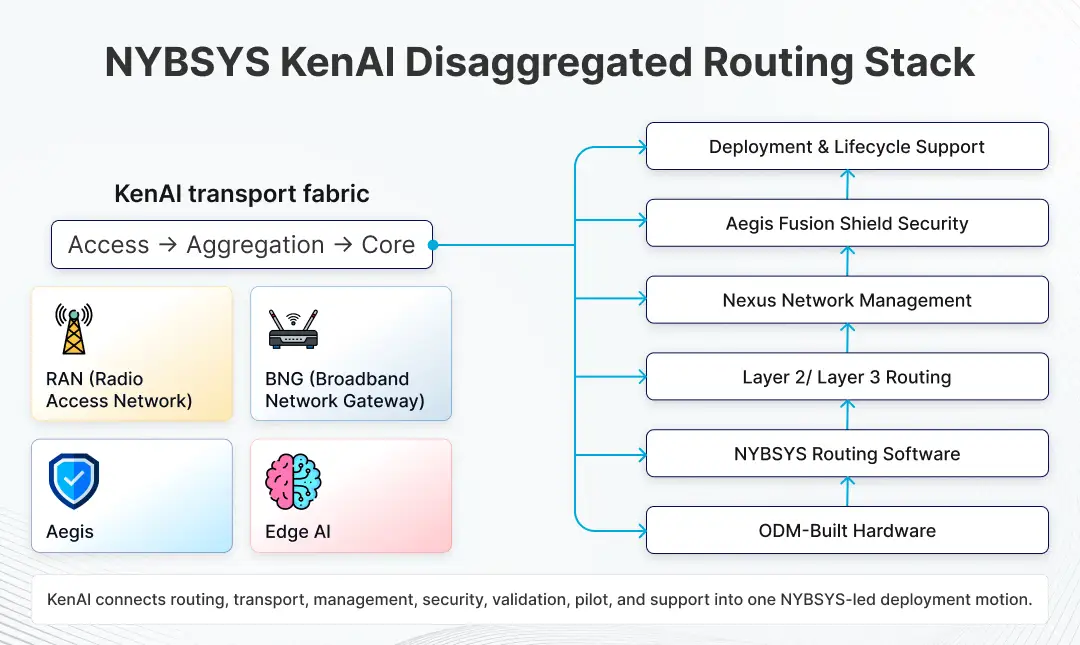
NYBSYS KenAI fits into disaggregated routing as an integrated transport fabric that helps teams separate routing architecture without making deployment feel fragmented.
Disaggregated routing gives operators freedom to choose hardware, software, management, and lifecycle paths. The challenge is that freedom can create operational complexity if every layer is sourced, tested, and supported separately. KenAI is designed to make that layered model easier to consume by bringing routing hardware, NYBSYS software, Layer 2 and Layer 3 routing, deployment support, and Nexus network management into one coordinated architecture.
From a network design view, KenAI matters because disaggregated routing is not only about replacing a router. It is about placing routing capacity where traffic is growing. KenAI can support access routing, aggregation expansion, edge transport, and core growth depending on the network plan, so providers can build capacity by use case rather than by a closed-chassis roadmap.
Deployment is another area where KenAI becomes important. In a distributed routing model, devices may be placed across many sites, towers, branches, or edge locations. NYBSYS promotes zero-touch provisioning so equipment can be prepared, shipped, powered on, authenticated, and brought into the management environment with less manual configuration. This supports faster rollout and reduces field complexity for large multi-site networks.
KenAI also becomes stronger when it is viewed with the wider NYBSYS architecture. 5G RAN environments need transport, timing, radio access, and edge connectivity to work together. KenAI can help connect those access environments into aggregation and core routing layers, which is important when traffic moves from radio sites, broadband access, or enterprise edges toward the wider network.
Nexus NMS gives the visibility and operational control that disaggregated routing needs. Open and layered architectures still require centralized monitoring, provisioning, alarms, and lifecycle workflows. By connecting KenAI with Nexus NMS, network teams can expand routing capacity without losing operational clarity.
Security is also part of the routing architecture, not a separate afterthought. Aegis Fusion Shield adds a security-aware layer for traffic protection, firewalling, resiliency, and service continuity. For operators that face DDoS threats or availability pressure, this security layer helps make disaggregated routing more reliable for production networks.
This is why KenAI is best understood as more than a router. It gives NYBSYS customers a practical path to open platform choice, carrier-grade transport, plug-and-play deployment, zero-touch provisioning, centralized management, security integration, and support from pilot to production.
NYBSYS KenAI makes disaggregated routing easier to consume, easier to deploy, and easier to operate across modern access, aggregation, and core networks.
How Disaggregated Routing Works in Simple Terms
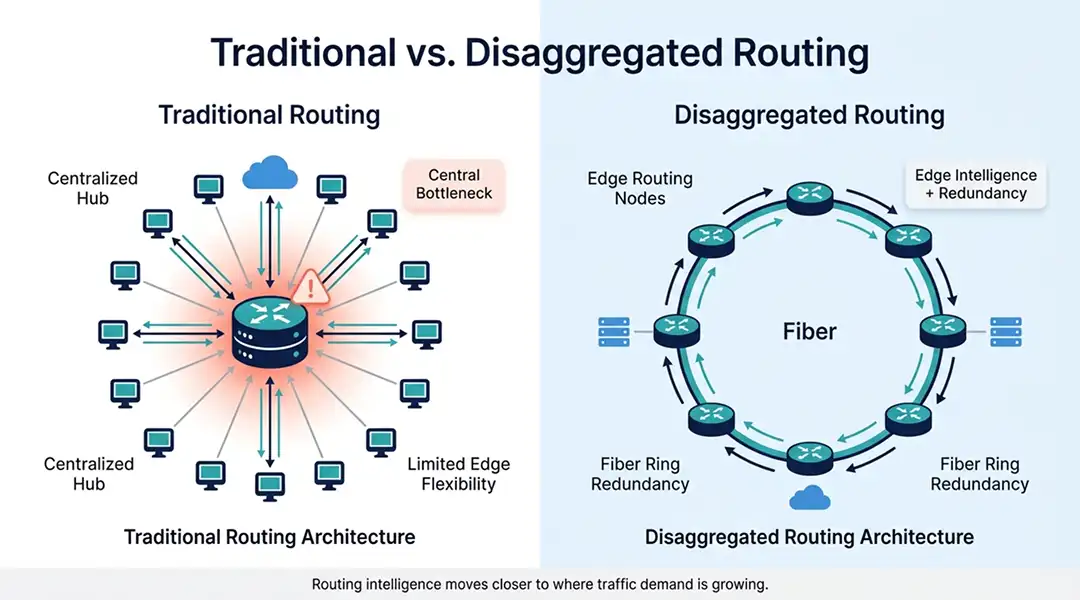
Think of traditional routing as a hub-and-spoke model.
Many endpoints depend on a central routing location. If the center becomes overloaded, edge performance can suffer. If a link fails, traffic may have fewer available paths.
Disaggregated routing supports a more distributed model.
Routing capacity can be pushed closer to the edge. Instead of making every endpoint depend on one central location, routing intelligence can be placed where traffic is growing.
For example, a broadband provider may want to deliver higher speeds to homes, businesses, or cell sites. To do that, the network needs more capacity closer to the customer. Disaggregated routing can support this by deploying smaller routing systems at edge locations with multiple fiber paths and better redundancy.
This gives the network more flexibility.
If one path fails, traffic can be rerouted through another available path. If one edge location needs more capacity, routing resources can be scaled closer to that demand.
Migration Does Not Need to Be a Full Replacement
One of the biggest concerns about disaggregated routing is migration risk.
Most enterprises and operators cannot replace their full network at once. They already have existing routing platforms, switching systems, firewall environments, monitoring tools, and operational processes.
A practical disaggregated routing strategy should support gradual migration.
NYBSYS KenAI can be introduced through a phased approach. This allows organizations to test, validate, and expand without unnecessary disruption.
A safe migration path usually includes:
1. Network Assessment
Review the current routing architecture, traffic flows, hardware lifecycle, bottlenecks, routing protocols, redundancy, and business goals.
2. Architecture Planning
Decide where disaggregated routing should be introduced first. For many organizations, the edge is the best starting point.
3. Lab Validation
Test routing behavior, performance, integration, management, and failover before production deployment.
4. Pilot Deployment
Deploy KenAI in a controlled production environment. This helps the network team validate real traffic behavior before wider rollout.
5. Production Rollout
Expand gradually across more sites, paths, and routing zones.
6. Monitoring and Optimization
Use Nexus network management to monitor the routing environment and support ongoing operations.
This approach helps reduce migration risk while still moving the network toward a more flexible architecture.
Where Disaggregated Routing Delivers the Most Value
Disaggregated routing is most useful when the network is growing faster than traditional infrastructure can support.
It is especially relevant for:
- Telecom operators
- ISPs
- Broadband providers
- Data centers
- Managed service providers
- Enterprises with distributed branches
- 5G and edge network environments
- Organizations facing hardware refresh pressure
- Teams trying to reduce vendor lock-in
This is not only a future concept.
GSMA reported that AT&T announced plans to deploy 60,000 disaggregated cell site routers. Ciena7 also cited Dell’Oro Group forecasting more than 30% compounded growth for disaggregated cell site gateway adoption over five years.
These examples show that disaggregated routing is moving from concept to real-world network modernization.
What Buyers Should Ask Before Choosing a Disaggregated Routing Solution
Before choosing a disaggregated routing solution, buyers should ask practical questions.
- Who provides the routing hardware?
- Who owns the routing software?
- How is the system managed?
- Can it support Layer 2 and Layer 3 routing?
- Which NOS options are supported or validated?
- Does it support BGP, OSPF, and the enterprise routing protocols the network already uses?
- Can it work with existing routing and switching environments?
- Does it support phased migration?
- How is failover tested?
- What does monitoring look like?
- What happens after deployment?
These questions matter because disaggregated routing is not only a product decision. It is an architecture decision.
The right partner should help with planning, deployment, integration, monitoring, and long-term support.
Final Takeaway
Disaggregated routing helps modern networks move beyond the limits of traditional monolithic routing.
It gives enterprises, telecom operators, ISPs, and data centers more control over hardware, software, scaling, management, and migration. It also supports a more flexible edge architecture as traffic grows and networks become more distributed.
NYBSYS KenAI brings this model into a practical solution. It combines NYBSYS routing software, ODM-supported hardware, Layer 2 and Layer 3 switching and routing, deployment support, and Nexus network management.
For organizations dealing with vendor lock-in, growing traffic, edge expansion, or expensive hardware refresh cycles, disaggregated routing offers a more flexible path forward.
Talk to NYBSYS About Your Routing Architecture
Moving to disaggregated routing should begin with a clear architecture review.
NYBSYS can help your team evaluate your current routing environment, identify scaling and cost pressure points, and plan a safer migration path.
Request a disaggregated routing cost analysis or migration plan to see how KenAI can fit into your existing network.
Frequently Asked Questions
What is disaggregated routing?
Disaggregated routing is a network architecture that separates routing software from routing hardware. It gives network teams more flexibility to scale, upgrade, manage, and deploy routing infrastructure.
How is disaggregated routing different from traditional routing?
Traditional routing usually bundles hardware, software, licensing, and support into one vendor-controlled system. Disaggregated routing separates these layers, giving organizations more flexibility and reducing vendor lock-in.
Why do enterprises need disaggregated routing?
Enterprises need disaggregated routing when traditional routing becomes too costly, rigid, or difficult to scale. It helps support traffic growth, edge expansion, phased upgrades, and better vendor choice.
Can disaggregated routing support BGP and OSPF?
Yes. Disaggregated routing can support BGP, OSPF, and other enterprise routing protocols when the chosen NOS and hardware platform support them. These protocols should be validated during lab testing and pilot deployment.
Does NYBSYS offer a disaggregated routing solution?
Yes. NYBSYS offers disaggregated routing through KenAI, a NYBSYS-owned routing solution supported by NYBSYS software, routing hardware, deployment support, and Nexus network management.
Can disaggregated routing work with existing networks?
Yes. A phased migration approach can help organizations introduce disaggregated routing while still working with existing routing, switching, and management environments.
References
- https://drivenets.com/resources/education-center/what-is-network-disaggregation
- https://www.ericsson.com/en/reports-and-papers/mobility-report/reports/november-2025
- https://gsma.my.site.com/mwcoem/servlet/servlet.FileDownload?file=00P6900002pVu5wEAC
- https://sonicfoundation.dev/
- https://www.ipinfusion.com/documentation/ocnos-feature-matrix/
- https://arrcus.com/
- https://www.ciena.com/insights/articles/ciena-joins-telecom-infra-projects-disaggregated-cell-site-gateway-dcsg-initiative-and-is-awarded-requirements-compliant-ribbons