

Connected Buildings
Smart building solutions for efficiency and automation
Smart City
Technology solutions for enhanced urban living
Public Safety
Critical communication and safety solutions
Connected Transportation
Technology for smarter, safer transport systems
Smart Factory
Advanced technology for optimized manufacturing
Smart AG Poultry
Innovative technology for efficient poultry farming
Nybsys 3Z Delivers Secure, Sustainable Network Solutions

Nybsys 3Z responds to three persistent issues in enterprise networking: slow deployment, insecure access, and unsustainable infrastructure. Even many service providers face these challenges regularly. For instance, devices take hours to configure, VPNs slow down remote work, and datacenters consume more energy than entire cities. Nybsys 3Z tackles these issues with Zero Touch, Zero Trust, and Zero Carbon principles.
Table of Contents
ToggleTL;DR
- Zero Touch Provisioning (ZTP) reduces network activities or costs by over 95% 1. It eliminates manual configurations that slow down LTE or 5G deployments.
- Zero Trust allows authorized users and devices to interact with your network. This model reduces breach impact and improves compliance with global standards like NIST SP 800-207 2.
- Zero Carbon solution transforms your network from an energy drain into an efficiency leader. It lowers carbon footprint and operational expenses simultaneously.
Nybsys builds energy-efficient platforms like EdgeLink and NanoLink, powered by renewable energy and optimized for low-latency 5G 3. Our systems support smart buildings, virtual presence, and remote diagnostics while reducing travel, power usage, and carbon footprint.
Throughout this blog, we will discuss how Nybsys 3Z impacts smart cities, industrial automation, and mission-critical networks. You will also learn how these Zero Touch, Zero Trust, Zero Carbon are faster, safer and greener!
The First Z: Zero Touch Deployment and Management
The traditional or manual network deployment timeline is usually 12-16 weeks for planning, installation, and configuration. However, this prolonged implementation hurts business growth and costs a huge amount of money. Manual configuration leads to errors and security gaps, which may result in costly downtime.
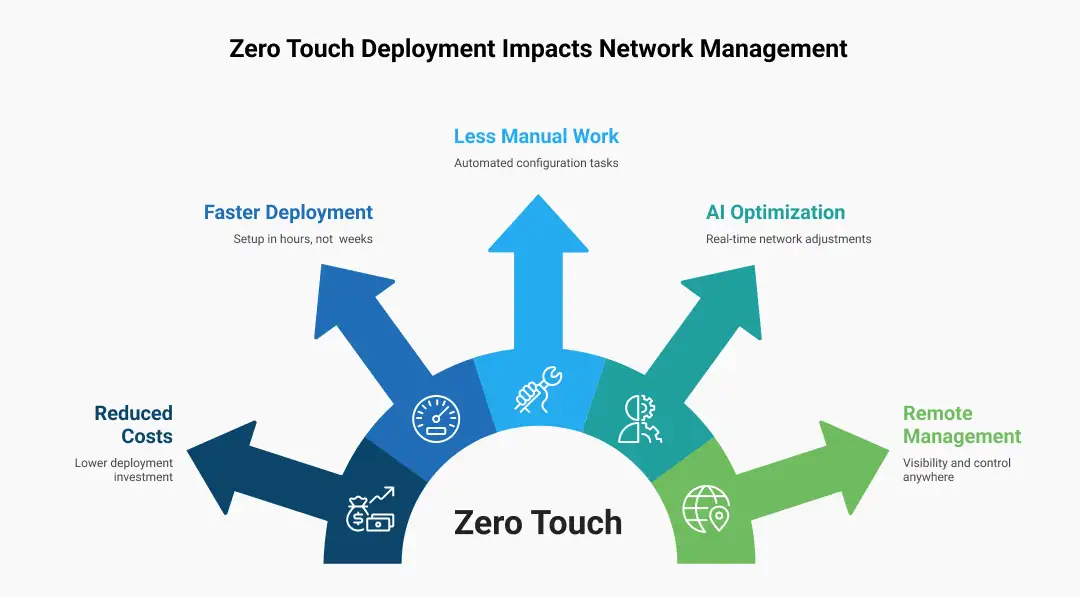
Nybsys Zero Touch fixes these issues. First, its plug-and-play feature eliminates the need for another $250K+ investment in deploying a macrocell site. You can set up a sustainable network at your place by spending below $500.
Through automated deployment processes, the ZTP system reduces the network deployment timeline to a day or even within 2 hours. You do not need to hire workers to set up a network like macrocell sites. Even with minimal knowledge and without any prior experience, anyone can deploy a network instantly.
Besides, it eliminates 80%-85% of manual configuration tasks. For instance, service providers or enterprises can monitor thousands of network devices through a single dashboard.
AI-powered network optimization in the Zero Touch principle continuously adjusts the network performance based on real-time conditions. The system may analyze thousands of parameters per second. This automatic adjustment helps to maintain optimal performance of a network.
In case of network interference or congestion, the system reconfigures itself within 30 seconds. So, the critical applications running in the network always have the necessary capacity. This self-optimizing capability or SON (self-organizing network) feature reduces the network management workload by around 68-72% to traditional networks that require manual tuning.
Zero Touch also includes remote monitoring and management, giving you complete visibility and control from anywhere. The platform provides real-time metrics on network performance, device status, and security events through a centralized dashboard. Nybsys Nexus is a network management system (NMS) or platform. It allows you to manage thousands of network endpoints from a single console.
Centralized management with Zero Touch reduces operational complexity and IT support costs. It allows IT teams to focus on strategic initiatives rather than routine network maintenance.
The Nybsys NanoLink and MicroLink solutions enable zero-touch deployment for 4G/5G small cells, reducing installation complexity dramatically. You get faster deployment with fewer resources and better results.
The Second Z: Zero Trust Security Architecture
The average data breach cost was $4.88 million in 2024, a 10% increase from the previous year, as IBM said 4. This is because conventional security models often fail to protect modern networks. You cannot rely on perimeter-based defenses when attackers are already inside your network. Most security incidents involve compromised identities, exposing weaknesses in legacy access controls.
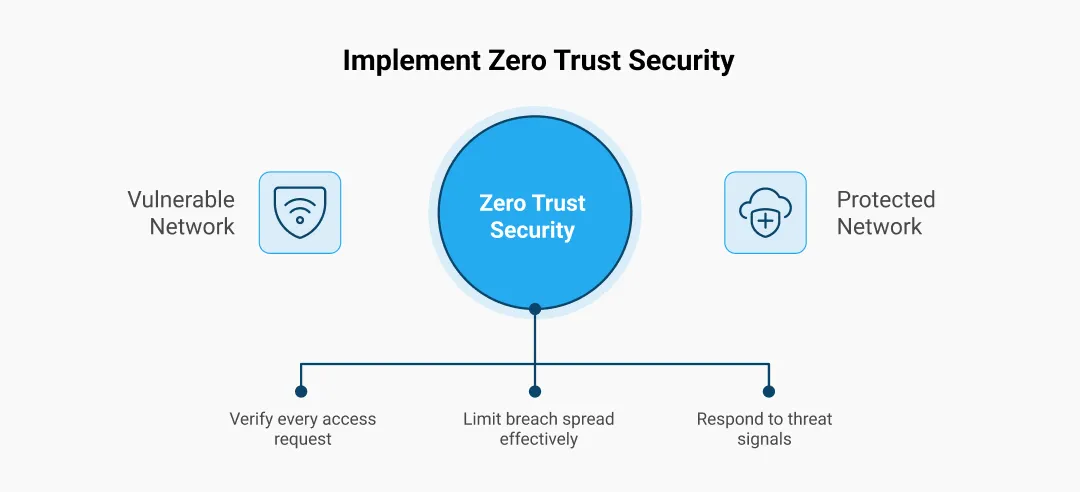
Zero Trust security eliminates these vulnerabilities by verifying every access request. This framework follows a simple principle: “Trust nothing, verify everything.”
According to Cloudflare, Zero Trust is an IT security model. It requires strict identity verification for every entity trying to access a network 5. They say, “no one is trusted by default from inside or outside the network.” Let me explain this in simple terms.
Zero Trust verifies every user and device before accessing it. It splits networks into hundreds or thousands of secure segments through micro-segmentation to limit breach spread. This granular segmentation is essential when you operate interconnected systems where a single vulnerability could cascade across your entire operation.
Multi-factor authentication and policy enforcement mechanisms adapt to your operational context. The system evaluates over 50 contextual factors before granting access, including user location, device status, time of day, and network behavior patterns. When anomalous activity is detected, the system can automatically adjust access permissions or require additional verification within 200 milliseconds.
Nybsys implements Zero Trust in all networking products, including small cells, security gateways, switches, and NMS. Our system verifies every user and device attempting to access your network resources. Plus, you gain continuous monitoring and adaptive authentication that responds to threat signals in real-time. So, your sensitive data stays protected even when employees work remotely.
The Third Z: Zero Carbon Energy Efficiency
The global electricity consumption from data centers amounted to 460 terawatt-hours in 2022. Also, it is forecast to be more than double to 1.1 petawatt-hours by 2026 6. This statistic shows that there will be more energy consumption as people need more network infrastructure.
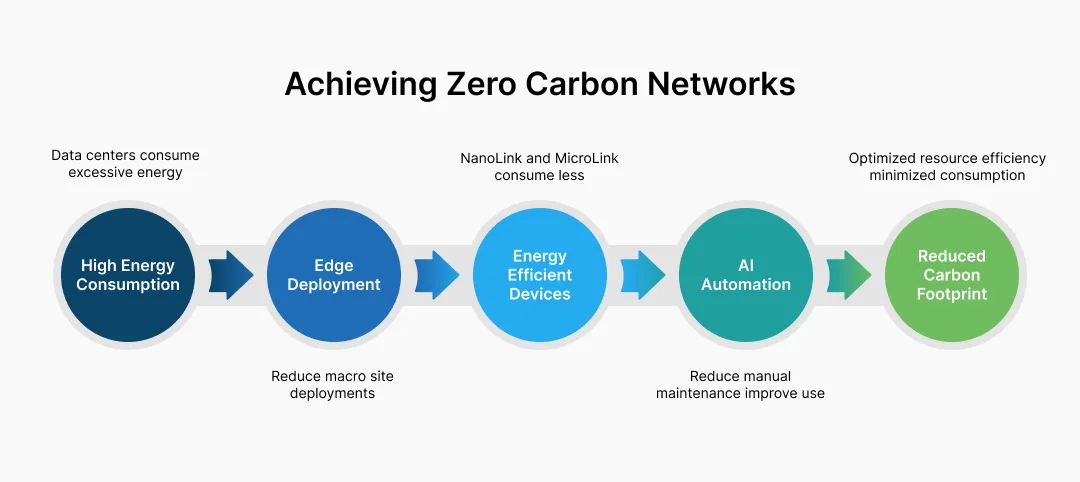
Excessive energy consumption leaves a carbon footprint that “signifies the cumulative greenhouse gas emitted from the lifecycle of digital network operations, infrastructure, and utilization” 7.
Traditional base stations or macrocell sites consume 1200-1500 watts per unit. They need consistent power sources, including solar panels, which is costly. But the Zero Carbon principle reduces this huge consumption rate. For instance, on average, Nybsys optimized equipment like NanoLink operates just at 15-50 watts and MicroLink at 15-100 watts. These products have PoE/PoE+ features which is very convenient in applications.
Following the Zero Carbon framework, our devices are deployed on the edge to reduce carbon emissions by lessening macro site deployments. More precisely, a network built with Nybsys products offers a 75x reduction in energy consumption. Also, small cells like NanoLink are 400 times energy efficient than running one macrocell site.
Service providers do not need to deploy costly macrocell base stations when our Nybsys Zero Carbon products can fulfill the same purpose. Instead of a base station, they can implement plug-and-play devices where the users demand a network.
The AI-automation and SON features reduce manual maintenance and improve network use. For instance, an outdoor base station or macrocell site may need to work 24/7 throughout the year to provide a network to users. It involves massive energy costs and enhances the chances of errors and defects in equipment.
On the other hand, small cells placed at the edge can be more energy efficient due to network automation. They may turn off automatically during less demand or off-peak hours. Also, the SON feature detects faults and solves them instantly. This way, more energy can be saved. It benefits service providers since end users may need to pay for the energy for as long as they use the network equipment or turn it on.
Nybsys is working with the motive of SBTi to achieve net-zero emissions by no later than 2050 8. We design our products to optimize resource efficiency and minimize energy consumption across the network infrastructure.
Zero-carbon networks also offer financial benefits. These networks reduce operational costs by thousands of dollars annually. Besides, customers and stakeholders recognize the commitment to sustainability, enhancing your brand reputation.
Benefits of a Network that Features 3Z
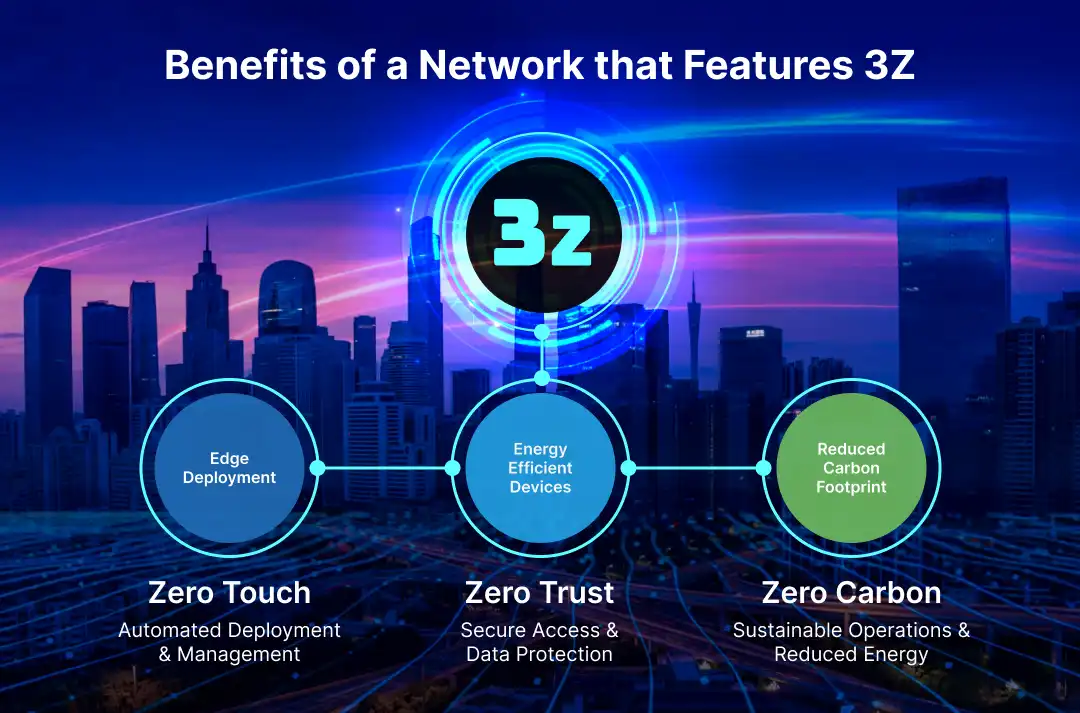
If you deploy a network following the principles of 3Z, it will offer multiple benefits. Nybsys products also do the same.
| Pillar | Key Benefits | Impact |
|---|---|---|
| Zero Touch |
|
|
| Zero Trust |
|
|
| Zero Carbon |
|
|
Applications of Nybsys 3Z Framework Across Industries
Nybsys 3Z is not limited to telecom. We are already transforming manufacturing, healthcare, logistics, education, and smart cities.
Nybsys Private 5G Express delivers five-minute boot time in industrial automation and supports over 8,000 push-to-talk sessions per deployment. This enables real-time coordination between machines, sensors, and workers. You get zero-touch provisioning, zero-trust access, and near-zero latency—all in one box.
Manufacturing plants use 3Z to reduce downtime and improve safety. Nybsys Sentra PTT integrates with IoT sensors and robotics to instantly monitor equipment health and trigger alerts. You can deploy predictive maintenance, automate workflows, and isolate threats without halting production.
Zero Trust segmentation blocks ransomware propagation, while Zero Carbon infrastructure cuts energy use by optimizing edge computing and cooling.
Smart cities benefit from 3Z through scalable, secure, and low-power networks. Nybsys NanoLink and EdgeLink platforms support smart lighting, traffic control, and public safety systems. These systems run on Kubernetes-based microservices, reducing carbon footprint and improving uptime.
Healthcare and education sectors use 3Z to protect sensitive data and ensure reliable connectivity. Hospitals deploy Nybsys 5G for remote diagnostics and real-time patient monitoring.
Schools use it for secure campus-wide Wi-Fi and virtual learning. You get complete control over access policies, device authentication, and data flow—without compromising speed or sustainability.
Frequently Asked Questions
Zero Touch Provisioning automates the setup of network devices without manual configuration. Devices connect, retrieve settings, and become operational on their own.
It improves data protection, reduces attack surfaces, supports remote work securely, and ensures compliance through detailed logging.
Zero Carbon refers to activities or technologies that emit no net carbon dioxide into the atmosphere.
Nybsys uses micro-segmentation, least-privilege access, and real-time threat detection across its platforms like Aegis Security Gateway and Nexus NMS.
Final Words
Nybsys 3Z combines three core principles (Zero Touch, Zero Trust, and Zero Carbon) to solve real problems in networking. You get automation that eliminates manual setup, security that verifies every access, and infrastructure that consumes less energy. These pillars deliver fast, secure, and sustainable networks for industries that demand reliability and efficiency.
Zero Touch simplifies deployment and management. Zero Trust protects your data and systems from internal and external threats. Zero Carbon reduces energy usage and operational costs. Whether you’re running a smart city, a manufacturing plant, or a healthcare facility, the 3Z framework adapts to your needs and scales with your growth.
You don’t need to wait to modernize your network. Start with Nybsys 3Z and experience the difference in speed, safety, and sustainability.
Visit nybsys.com to explore solutions, request a demo, or speak with a specialist.
References
- https://www.tanaza.com/blog/zero-touch-provisioning/
- https://nybsys.com/zero-trust-security/
- https://www.lannerinc.com/news-and-events/latest-news/lanner-and-nybsys-unveil-next-gen-networks-and-gen-ai-applications-at-mwc-2025
- https://www.cloudflare.com/en-gb/learning/security/glossary/what-is-zero-trust/
- https://www.ibm.com/think/insights/cost-of-a-data-breach-2024-financial-industry
- https://www.statista.com/topics/13055/data-center-power
- https://energy.sustainability-directory.com/term/network-carbon-footprint/
- https://sciencebasedtargets.org